Topics:

Showing posts with label Social Media. Show all posts

Thursday, September 4, 2014

Facebook's Responsibility (#17)

What should we expect from our tech overlords?   

Every so often, someone throws up the R word (it’s in the title), and businesses are called on to justify their existence beyond maximizing revenue and profits.  Facebook has been put in the public crosshairs a few times this past year.  There are concerns that Facebook is manipulating its user’s emotions, that its ads are uncomfortably well-targeted, and, most recently, that Facebook dumbs us down by showing us spammy, substance-free garbage.  On the last issue, Facebook has announced its plan to reduce its link-baiting content from sources such as Buzzfeed and Distractify.
 
There are plenty of legitimate gripes about Facebook.  The research is pretty clear on the power of Facebook to make us feel alone rather than connected.  The site is surely addictive, and it really is our responsibility to avoid being on it all day.  Wait, I think I’m jumping the gun on my main point. Let’s dig into the Buzzfeed issue and try to apply a reasonable standard, gripes aside.  

Why is my newsfeed full of articles like “17 Animals That Are Not OK With Sweater Weather" (no, I will NOT link to that)?  Facebook has a complex newsfeed algorithm based on likes/shares/comments and the poster’s relationship to you.   We see spammy content because this is what a lot of our friends, even the smart ones, like to read when they are browsing.  The algorithm would begin to phase the junk out, if you didn’t like it a little bit as well.

This is where the R word comes in.  First are my arguments against a social responsibility for better content:

If Upworthy puts more eyeballs on Facebook for longer, it is good from a shareholder’s perspective.  Surely we don’t apply a standard of right and wrong in industries like, for example, cleaning products or batteries or appliances.  In most industries we applaud rather than complain when an innovation wins out.  For the Menlo Park, California company to alter its newsfeed would be a significant exception to its goal of maximizing user engagement (and by extension, ad dollars).  Maybe this strategy might be more profitable from a user experience perspective in the long run.  Yet, if we assume the company has smart decision makers (it certainly has the money to hire them), we wouldn’t need critics to demand a change based on responsibility when self-interest would suffice.  The content is here because, by and large, we like it. All hail Buzzfeed, the new leader in journalism. Let’s not impose our higher ideals on other Facebookers and instead let live.

And by now I bet you're jumping out of your seat waiting to give me counterarguments, in favor of Facebook’s social responsibility:

The social media industry has switching costs so great that it does not function properly (what are you going to do, use Google+?).  Financial pressures encourage Facebook to think short term as opposed to long term.  We can acknowledge behavioral scientists who show that small corrections can “nudge” people to much better decisions (we could demand a limit to linkbait, or use a more creative approach such as making link font be smaller and red and have a disapproving emoticon next to it. See mandatory nutrition facts - shame works).  In these cases, a course correction could be in both the public and private good.  At some point can’t we call a spade a spade and say Distractify is a bad influence?
 
Yes, I believe we can say objectively that reading spam is worse for society than staying informed.  Businesses, even armed with tons of data, do not always produce the best products.  Part of the problem is Facebook’s fault, because people (myself included) have limited self-control and will click on, read and eat what is in front of them.  

Also, maybe we shouldn’t look businesses to be our saviors.  Just as you wouldn’t demand Kellogg to make Poptarts healthy or Sony’s Playstation help you get fit, we shouldn’t demand a social media company be not something it is not. 

Facebook is not the New York Times.   My main point is that we should not wait and expect Facebook to act in the public good, and instead should look inward to improve our habits.

For those who believe thinking and learning is important, what could we do instead?  We can unfollow spammy sites (or spammy friends) in our newsfeeds, unsubscribe to our junky sources, and shame ourselves to consciously avoid clicking on what we know is a waste of time.  The same consciousness can apply to Facebook.com as a whole.  Set a (clear and public) limit of how much you will visit unproductive sites without first doing what you need to do.  We can and should adopt a growth mindset and say, “I have the capacity to change and make reasoned decisions” so that we keep Buzzfeed to a sometimes snack.  I still believe in us. 

What do you think?  What should Facebook *have* to do?  What should it *want* to do?  I appreciate everyone’s thoughts.

*This post is strongly influenced by the tech strategy podcast Exponent.  If you like this topic, check it out here.

Thursday, April 10, 2014

How to Drive Clicks and Grow Your Business…Just Kidding. (#14)

An Ordinary Guy’s Lessons Learned in Boosting Web Presence.

Full disclosure: I’ve been doing experiments on you.  Don’t worry, it’s nothing sinister.  I’ve been shortening links I put on Facebook and Twitter, because then I can track how many times it’s been clicked on and when.  It’s all anonymous, but interesting nonetheless. 

As a guy beginning a career in data analysis, I believe that virtually all actions we take can be quantified, especially online.  Any company that is not collecting data, and learning or finding relationships in it, is missing out on ways to do better at what they’re doing.  So I track, and so can you!

Hi Orli!
Social media: you're doing something right.
When we’re being honest with ourselves, all behavior on social media is at least a bit narcissistic and self-centered.  If you didn’t care at all who saw and engaged with your updates, you would write a diary instead.  I try not get wrapped up in like-baiting. After all, social media is fun and shouldn’t be taken too seriously.  Yet, it would good to have a grasp on how people behave online if I ever go into marketing. In my job I will learn how to be statistically rigorous and all that jazz, but for now I’d just like to share my anecdotal findings about how/when/where I post.  Here they are:

1. Conciseness works.  I used to give a full opinion on the articles I tweet, barely staying under the character limit.  But, I’ve seen time and time again that less is more—if I just say “this is the future” or “a strong argument”, I’m more likely to be noticed in the feed.
                                               
2.  Headlines matter.  This may be obvious, but at least I’ve confirmed it myself that a call to action, with important words in the front, leads to more engagement.  There will be consequences if your content continually does not live up to its headline, but at the basic level you need something that drives another person to care.

3. Facebook accounts for at least 80% of my social reach and network.  My peers spend much, much more time here than Twitter, Google+, Tumblr, LinkedIn, or anywhere else.  An average article I post on Twitter gets 1-3 clicks, but on Facebook even silly stuff I put on Facebook gets more than this.  Of course, I’m not a Twitter or blogging star, and imagine this pattern would reverse if I made a greater effort to attract people I don’t know on these platforms.

4. A retweet, like, comment or +1 soon after posting significantly increases reach.  Facebook, Twitter and Google’s algorithms may be complex, but clearly engagement increases the amount of times your stuff pops up on a screen.  Not only this, social proof takes hold, and people want to be in on what others around them know about and have verified is good content.

Today (this was the basis for my post) I linked an article where people mined eHarmony data and found people look to date those quite like themselves, even if they say the opposite.  Pritika, a friend with a near-superhuman network of friends (Hi Pritz), commented one minute after I posted an article, saying This is so interesting. thanks for sharing J.Lew”.  It was the perfect comment to get others interested. In fact, if I did social media for more than fun, I would agree with my partners to comment on each other’s content, because it works.  In a couple of hours I had over 70 clicks.  Another factor is the topic, which fits college students like: readable but also potentially informative stories. Ultimately, the goal is not to get clicks for their own sake but to tailor my stuff so that my friends enjoy my web presence.  No one likes the guy posting about Ayn Rand three times a day.

5. Don’t post at 2 in the morning. Even those who rarely use social media would agree yelling to someone is better than yelling to no one.  Wait until 11am for Facebook, and 1pm for Twitter.  I started posting my #MusicMondays updates (check out my blog post on this! Or not) at around 2 pm, as the internet tells me that is the peak of web traffic.  In time, I’ve learned my demographic is at least as active around 8 or 9.

6. I don’t like to engage in Facebook political wars, because I’m not 16.  But every once in a while, I ask people what they think about the news.  As a rule, if you want comments (or retweets, or whatever), you should ask for them.  As serendipity would have it, a post about the ACA earlier this year began a long discussion, bringing in the views of most of my different friend groups.  I returned to the computer that evening with shares and an absurd amount of clicks, probably my highest ever.  This is social media functioning well: content spread which inspires people to stop scrolling, to think and respond.  Or maybe I got lucky.

Let me know your thoughts.  Is casual analysis of your social media a waste of time?  Is there an easy way to do this more scientifically?  If it worth a few seconds of extra effort to post better stuff on average?  

Wednesday, June 26, 2013

Facebook Knows When You're Sad (#2)

#102 – Facebook Knows When You’re Sad


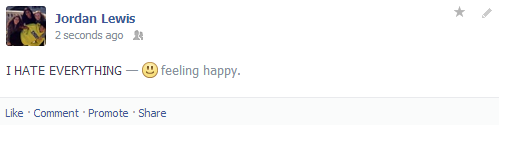
I knew what Facebook was doing.  As soon as it gave us the option to put a standardized set of a emotions next to our statuses, I knew crafty ad men were at work.  But first, let me back up.

Computers (and those programming them) have been working hard for decades to better understand the quirks and nuances of language.  Natural language processing (NLP) is, depending on who you ask, another step towards the robot apocalypse, an exciting path towards “talking” to our devices, a new method of documenting and understanding our feelings, or a chance to make bank. 

But, regardless of the implications, NLP has a long way to go.  A computer program could very confidently determine a melancholy tone if you type “I am sad”, but what about “I am crushed by bowling balls that represent the weight of my problems” or “Being on hold for hours with Comcast is SO MUCH FUN”?

I’m going to avoid the additional hurdles of spoken word processing (like accents and inflection) and instead stick to text.  The example that got me thinking about this was Eric Gilbert and Karrie Karahalios’ study on LiveJournal blog entries and their ability to predict the stock market (which I read about in Predictive Analytics – great book and easy read!).  Eric and Karrie did not attempt to guess the emotions conveyed by certain words, and instead compared million of entries with Livejournal’s option to label posts as “happy”, “sad”, “anxious”, and more.  Finding correlations between, for example, the use of phrases “really scared” or “care-free” and the likelihood of placing a positive label, allowed the two men to predict the anxiety level of a post by analyzing the text, even without a labeled emotion.  The analysts then aggregated recent posts on LiveJournal, and later combined other blog sites, to form an overall anxiety index, on the hypothesis that higher anxiety among internet users would predict stock market drops (and vice versa).  In case you were wondering, this approach was successful for a while, until it wasn’t. Now, it appears Facebook wants to build its own emotion-prediction model for the purposes of ad targeting.

How deeply will Facebook’s system penetrate our heads? It’s hard to say, but the most valuable (and coolest) part about predictive models is their potential to find unintuitive, even bizarre relationships.  Maybe a model will find something totally unexpected, like if people click on more political ads when hungry, or buy more pens, but fewer staplers when feeling excited.  It would be unlikely a human, lurking on our statuses, could make these connections, even if they worked as blisteringly fast as a computer running a million little optimization experiments. The social network could then optimize promotions for its partners by placing them only in feeds when Facebook users are in the mood to see them.  This is a ridiculous level of targeting.

Privacy-zealots, big data-skeptics and some casual internet browsers will find this inherently creepy and even dangerous.  This is a topic for another post.  However, I’m not too bothered, and am inclined to let Facebook try and guess what I’m thinking, and give me ads I’m slightly less likely to ignore.  Even so, those sneaky stat guys might find I’m privy to their game, and am happy to mess with them.