Topics:

Tuesday, November 5, 2013

Genres, Words, and Communicating Musical Taste (#12)

I started posting #MusicMonday's, in the hopes that I engage some people out there to discuss, listen and share music with me. Music is better together.

Here are my recommendations, if you're interested.  I'd highly appreciate thoughts:

1. Jose James and Emily King - Heaven on the Ground (http://bit.ly/1gjSsjR)
2. Snarky Puppy - Too Hot to Last (http://bit.ly/19JnACa)
3. Gretchen Parlato - How We Love (bit.ly/186isbH)http://http://bit.ly/186isbH
4. Kimbra - Settle Down (http://bit.ly/19NJgAy)
5. Robert Glasper ft. Norah Jones - Let it Ride (http://bit.ly/1djlphh)
6. Gotye - In Your Light (http://bit.ly/1czY9eo)
7. Lettuce - Break Out (http://bit.ly/1aNuFCm)
8. Q-Tip - Johnny is Dead (http://bit.ly/1e6m7uf)
9. The Bad Plus - Everybody Wants to Rule the World (http://bit.ly/1gygW7W)
10. Stan Getz - Wave (http://bit.ly/1fBXLtY)
11. Gretchen Parlato - Holding Back the Years (http://bit.ly/1dxtaA4)
12. Childish Gambino - Telegraph Avenue (http://bit.ly/1ciNHRK)
13. Frank Ocean - Sweet Life (http://bit.ly/1985oJc)
14. James Fauntleroy - Fertilizer (http://bit.ly/1iKjvVA)
15. Ratatat - Cherry (http://bit.ly/1eNVH0l)
16. Oscar Peterson - Please Don't Talk About Me When I'm Gone (http://bit.ly/1ppi1RG) 
17. Nujabes - Feather (http://bit.ly/1esKoNm)
18. Hard Jazz - Greg Spero (http://bit.ly/gregspero)
19. Pat Metheny - Medley (http://bit.ly/1gcheAi)
20. Robert Glasper - Butterfly (http://bit.ly/1duP4lU)
21. Joshua Redman - Let it Be (http://bit.ly/RedmanLetitBe)
22. Chance the Rapper - Cocoa Butter Kisses (http://bit.ly/ChanceCocoaButter)
23. J Dilla - Lightworks (http://bit.ly/1iU2Yzi)
24. Snarky Puppy - What About Me? (http://bit.ly/1lGxiyd
25. Bill Evans - My Bells (http://bit.ly/BillEvansSymphony)
26. Kanye West - Champion (http://bit.ly/KanyeChampion)
27. Russ Kaplan - Gouge (http://bit.ly/1rG8skR)
28. Nujabes - Latitude (http://bit.ly/1pbNkEg)
29. Gabe Dixon - Strike
30. Jose James - Without U (http://bit.ly/JosejamesWithoutu)
31. Funky Knuckles - Shields of Faith (http://bit.ly/1nYkvpJ)
32. Isaac Hayes - Shaft (http://bit.ly/1of6xQv)
33. Soweto Kinch - Good Nyooz (http://bit.ly/1p8SZch)
34. Pat Metheny - Finding and Believing (http://bit.ly/1o9gOlv)
35. Eels - Susan's House (http://bit.ly/1uIDk5w)
36. Lionel Loueke - Ife (http://bit.ly/1pBi2WO)
37. Bill Laurance - Swag Times (http://bit.ly/1srUl2b)
38. Kimbra - Nobody But You (http://bit.ly/W4mO3u)
39. Alan Hampton - Change Your Mind (http://bit.ly/1DcfxjL)

But this leads to a topic for reflection: I've been having more trouble as of late communicating with others about music.  I believe this is mostly on me because I keep changing while in aggregate nothing has changed in the college music scene in the past year or two except maybe a leveling off of our dubstep fixation.

Background for those who have known me for a long time: I'm a jazz guy by trade.  That was what I learned when I started the piano at 13, what I went to programs and did regional bands with in high school, and was the bulkload of my listening, writing, and musical discussion through age 19.  I loved it.


But I don't define myself by it anymore.  Growing up we're placed on pre-defined musical "tracks", the main ones being classical, jazz and rock.  With few exceptions, private teachers will focus on one of these three, schools will offer classes and ensembles in just the first two, radio stations will label themselves one of the three (or pop, but this genre's lowest common denominator nature is definitely a topic for another day), and communities formed under one of these three umbrellas will have a much larger following.  Initial interest put me in the jazz track, but I could have been happy if there was a strongly-supported "funk", "soul", or "jam" track instead.


One of the most important things I learned in college was to be more open-minded (and open-eared) and to seek diversity of knowledge.  But, while genres serve a clear purpose of providing catchall terms and pointing listeners in a general direction, they put up arbitrary walls.  Just like, for example, 2-party political systems or college majors, those in between labels are unintentionally marginalized and encouraged to conform.  We lessen the problem by creating more, more amorphous labels like "ska" or "adult contemporary", but none of this makes it easy when I am asked the classic ice-breaker, "what kind of music do you like?".


This gets at the big question: How do get our music preferences across (to both the musically-passionate and dispassionate) without pigeonholing ourselves into genres, using cliche descriptors like "acoustic", "hard", or "funky", or coming off as totally snobby?


First, I recognize it's not crucial that I be perfectly understood anytime sometime asks me about music.  But, for the segment of the population who loves music and talking about it, I'd love to be able to explain more precisely than:


"It's kinda like jazz and funk and soul and modern, usually dense harmony, with heavy or occasional improvisation, riffs, smooth voice leading..."


And remember, I'm trying not to come off as haughty or trying to prove something.  That's the hard part.  But 2013 labels simply don't do Jose James or Gotye or Lettuce justice.  Here's the common iTunes designations for my recently played music of the past 18 months:


Jazz - Funk - Modern Jazz - Alternative - Hiphop - Fusion - Jazz/Alt. - Blues - Classic Rock - Soul  - Jazz/Funk


This vocabulary is limited and not particularly helpful.  


Here has been recent approach in reaching a "meeting of the ears" with friends: wait and listen to 3 artists they like, and play first the midpoint between your musical comfort zone and theirs.  For example Katie played rap, but seemed to like both substantive/"real" lyrics and intense harmonic grooves, so I played Robert Glasper (who's totally awesome)  Adam came from a traditional jazz track, but also has a soft spot for female pop singers and updated/messing with the trad jazz formula, so I passed on Gretchen Parlato.  My roommate JFran is an interesting case.  He's one of the only people I know who listens to more music than me, but Matrix-dodges my ability to label it.  He likes the rawness of local bands, electronic layers and integration, bands that sound like the Beatles were shoved in the 21st century, ambiance, acoustic guitar he can strum along to, and more (here's one example).  I went out on a limb with this by the cool folk group Bad Books, and we're slowly reaching some musical overlap.

So, my (reasonably practical) recommendation to everyone else who enjoy music: have 3 artists on the top of your mind that represent you, and have a shortcut to play them on your phone.  If everyone has music players with them at all times, we might as well stop confusing each other with words when sounds are worth a million of them.

Monday, October 21, 2013

Faith in Microsoft Restored - My Impression of Windows 8.1 (#11)

(If you missed my earlier thoughts about Windows 8, you can find them here.  There is a noticeably different tone on that post vs. this one.)

It has been exactly a month since I joined Windows 8 World.  I know this because my Office free trial ended, destroying my productivity for the day.  I've been getting good with integrating little new features while still generally ignoring Microsoft's Metro vision for how I should use my PC.  I got around to unclogging my start menu, though I Windows+D straight to desktop as a reflex anyway.  I dropped my files into Skydrive and have found most of the capabilities of Office 2013 that I already knew about on 2010. I even started using the touch gestures; sometimes it's easier to use Skype or my .pdf reader as an app if I can just swipe in an out.  I don't think the cursor's days are numbered, and my Metro start menu is still ignored, but I learned to at least clean house within my Microsoft-imposed hell.

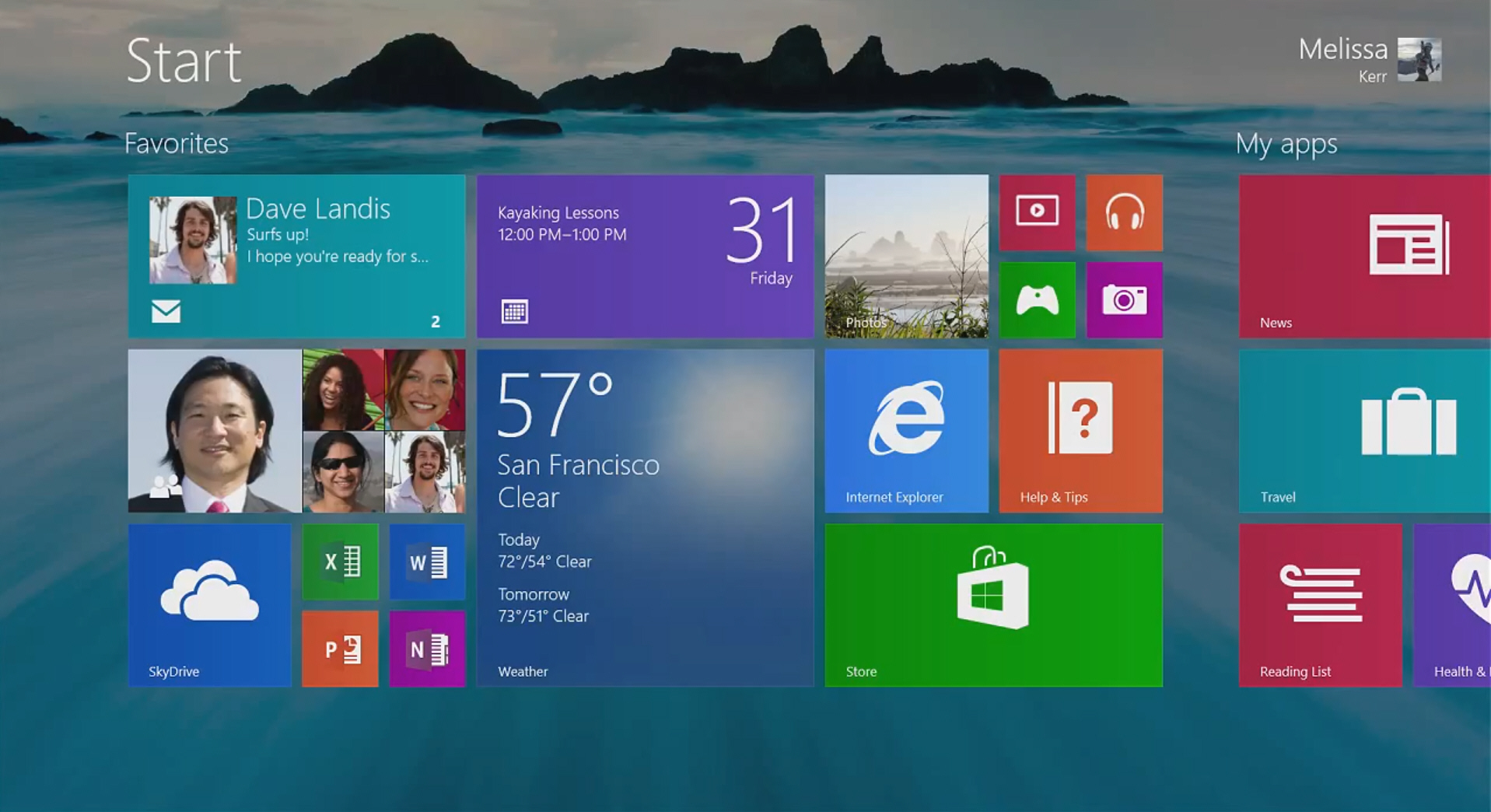
And then Windows 8.1 happened, and my faith in Microsoft to listen to its consumers was restored.  It's not like anything was that different.  The famous start button returns, the snapping tool gets more flexible, the start menu has new live tiles and sizing options, and the Windows store isn't a mess.  On the first day, I went about business as usual, rather underwhelmed.

But then I accidentally snapped a news app in, and realized I could resize it and move it around. Now I can actually meld Metro-world and desktop world, customizing my current screen and multi-tasking unlike how I ever could pre-Windows 8.  And then I decided, "If I'm going to actually use some programs as an app to take advantage of this cool view, I might as well organize my start menu."  My search for good icons brought me to the Windows Stores, which now prominently shows ratings and recommendations, while still feeling like there is more space than before.  I downloaded apps in a frenzy, treating my PC like a phone and fiddling with the layout (I'm pretty OCD when it comes to organizing technology) until I could conceivably spend most of my time in Metro mode.  Let's be honest; most 21-year-olds could survive on just social media, Chrome, Office, Amazon, Steam and Netflix for about 90% of their computer usage.  I noticed hundreds of apps that were probably in existence before 8.1, but ones I always ignored due to that small initial hurdle of confusion.  There's a beautiful little tool called Piano Time.  I was pressing pretty 6-note chords more easily than any fake piano I've tried.  And all the apps were waiting with a "NEW" tag in my All Apps area, now reachable with a swipe downwards on the touchpad.  I felt that "power-at-your-fingertips" feeling, where everything seemed intuitive and did what I wanted it to do, unlike how I felt the entire first 29 days.

All it took to make me realize Windows 8 wasn't awful was a a slight push to get me sledding down Metro Mountain.  My main thought now is: couldn't anyone have told Microsft to make its tools more flexible?  Wouldn't serious consumer testing have shown these minuscule changes would be worth making?  And if Windows 8 was so clearly inadequate and unable to change consumers, why did it take a year to polish?  I wouldn't mull over these questions, as you'll just get frustrated.
This guy is probably feeling good
for the first time in a while.

I could tell on first boot-up yesterday, when a tutorial spoke to me like an adult, but also didn't assume I've been sitting in a Redmond office with Steve Ballmer for a year, that Microsoft was listening.  But I'd like to see the company continue to update its UI at least every few months.  Google and Apple make near-constant fixes, and users expect no less.  With 8.1, Microsoft now has the software of 2013 to match its hardware of 2013, now it just needs the customer service and responsiveness of 2013.

Tuesday, October 8, 2013

Netflix, eBooks, iTunes - The Gang's All Here (#10)

How the digitalization of content resized all of our media, and what will happen next.

Twenty years ago, TV shows were 22 or 44 minutes only.  Best-selling books were 150-300 pages, newspapers were the size you could comfortably read with two hands, music albums 30-60 minutes, and movies 90-150 minutes.  Why?  Money and form constraints, mainly.  Content of all forms followed size patterns so that it felt substantial and worth paying for, but could fit on a VHS, or a CD, or be bound. 

Then the commercial internet was available, and everything changed.  Well, not immediately.  Albums and movies and books were still usually the same length.  It was still easier for consumers to start TV shows at the top of the hour, and invest in a book around 200 pages (i.e., not American Tragedy). It was what we were used to.

 
But then we got creative.  As the web matured and became more complete, we found no reason to restrict ourselves based on form. With virtual folders and 500 gigs of hard drive space, who cares whether an album is ten minutes or ninety?  Visual stories could be told all at once in a movie, but also five minutes at a time on Youtube, or just 5 seconds at a time.  I post to my blog ~500 words at time: no binding or publishing costs required.  Netflix throws its content at you seasons at a time, and what we can't find there we download by the season.  Digitalization means 'one size fits all' has become 'all sizes fit me'.

This is not news, per se, if you lived through the late 20th and 21st centuries.  But what I find most interesting is how entire industries have grown or gone away as a result of this paradigm shift.  Our binge-watching culture has given birth to a recapping industry; journalists share insight about a TV episode, and people who are at the same point find each other and discuss in the comments.  TV themes are shorter or hookier; no one needs to know the story of the Brady Bunch every time when they are watching 9 episodes in bed.  One of my favorite albums, Pat Metheny's The Way Up, is one 68-minute composition-no flipping of the record or tape or CD or even tracks were required.  News doesn't resemble itself at any time in history.  There are 13 million archived New York times articles but 17 billion Tumblr blogs.  I consider Twitter Vines (6 seconds or shorter videos) an art form, and film majors are actually getting discovered through Vine microfilm competitions.


The possibilities are great; here's a good example of new technology changing art.  I'm working on a project for class where I am helping E-publish a women's book.  Her non-fiction work about communist Russia spanned many regions, fields, and decades, and she described it as difficult to find the right order to present the information.  So I thought, why do we need a linear story?  Why not make a web of connected stories as they are in real history?  We could have a story about Lenin lead to stories about the 1920's, or to other revolutionary leaders, or to his faction, the Bolsheviks, depending on what reader wants to see next.  We could even visualize the story in a way books couldn't, with hundreds of embedded photos or videos.  And it could all be on a Kindle or iOS app.  I'll fill you in more as the project progresses, but you get the idea.


I fully expect TV shows to abandon the idea of standard episode lengths in the next five years.  The Kindle market has already done this for books.  As CDs die out, expect more and more artists to ignore the restraints every generation of musicians before them has felt as they try to record and promote themselves. Say goodbye to big-budget recording and music stores, say hello to Garage Band and SoundCloud.  Soon, no major human event, even in the developing world, will go unrecorded.  Expect a world where there is no "normal" media, few artistic standards, and no limits.  Are you excited?

Thursday, September 26, 2013

My Impression of Windows 8 - 1 Week In (#9b)

(My very first impressions are here)

My gut reaction (hatred) of Windows 8 has passed, but what remains is a lingering discomfort.  I found some of the important shortcuts (I go to desktop mode with Windows+D when I start-up or end up too deep in AppLand, and Window+ to cycle with snappy views) that quickly get rid of the strange layout where I often find myself.  I've learned to open programs like Google Chrome NOT as an app, though it's frustrating that the Adobe Reader included comes only in app form and required another download.  


The touch feature of many Windows 8 laptops appears mostly unnecessary to someone running in desktop mode, and I realized this when I noticed the majority of my touches to the screen have been to remove a hair or dust speck, which now causes an unwelcome scroll up or down.  It's possible I will find niche instances where I will save time moving my hand to the monitor vs. moving the cursor, but we'll have to see.  The swipe gestures using the touchpad were triggered inadvertently about 90% of the time, and I had to edit the registry to turn these "innovations" off.  My point that all these examples allude to is: 


My Windows 8 experience gets better as I get better at ignoring its irrelevant changes to what used to be a good OS.


The leap that W8 has failed to make with me so far is from "cool" and "useful in the abstract" to "useful in my real, everyday experience". The goal of an operation system that it still loaded onto over 4 in 5 new computers should not be to convince me it is cutting-edge or innovative. The ideal operating system for the mass market maximizes ease of use and minimizes confusion and frustration right out of the box.  And, for the love of god Microsoft, if you want to teach customers something now, you better have plenty of tutorials.  My concern is not for savvy Googlers like me who will willingly find workarounds to silly settings.  But for the hefty majority of older users (who are intimidated opening a command prompt, diving into settings or even using a search engine), the net result is not learning to snap and swipe and swing and scroll like Millenials or thinking that Microsoft is relevant again. The net result is simply wasted time looking up tasks users knew how to do for the last fifteen years.


I understand that, from Microsoft's perspective, few people would be convinced to use the new features the company staked its future on if users had to opt-in to experience them or if it was easy to quickly turn them all off.  But there need be no choice between cool and usable.  Mac OS and iOS are both so easy a cavemen could learn them.  Android adds customization to the iOS formula while being only slightly less intuitive.  The Windows 8.1 update, while embarrassing in the sense that Microsoft either diluted or removed a number of the risks it took, is encouraging that the company can admit its mistakes. Microsoft is making the transition to an internet-based company like Google where failures are reversed quickly with updates.  A year to correct glaring goofs is forgivable...for now.


Saturday, September 21, 2013

My Impression of Windows 8 (#9)

I joined the Windows 8 world yesterday (9/20) after my Toshiba met a rather timely death after over 3 years of solid service.  RIP Toshiba.  Anyway, I've read about Microsoft's crazy year-old experiment for, well, a year now, and wonder what I will think if I commit myself to figuring it out and using the Metro interface to its fullest.

I expect my opinion to change dramatically over time, so there will be periodic updates.

9/21

Warning: Snap judgments ahead.

I hate it. I hate change.  I just want my computer to be a computer, as I have defined it in my head.  I'm among the first generation to have the internet my entire life (my family got our first computer when I was 1, and it accepted only floppy disks), but Windows 8 makes me feel like I'm old and don't understand technology.  I'm being tossed into the abyss of tiles, touch, and terror. My burning questions so far:

1.  Why, when I open Chrome, do I get a crazy view with no buttons at the top of the window and no icons below, but in Internet Explorer I get a view similar to the classic interface?

2.  Why, when I download a file from the web, is there no option to open file location?

3. Why is search, an integral part of any OS, hidden?  The only way I've been able to do it is my swiping from the right, and then selecting files within search.  Why not default search everything?

3. I was warned about the fit/resolution issues, but I still wasn't prepared for this teeny tiny height on the text, url bar, volume etc.  Why does Microsoft insist that I feel like an old person?

I will watch some tutorials and and start personalizing my live tiles, but I wonder why Microsoft did not send me a high quality tutorial upon first startup.  In what way is the tile view intuitive to any first-time user?  Just getting to Youtube and switching to the more familiar view was like walking a dark creepy forest of Microsoft's creation, and they wouldn't even hold my hand.

More to come.  If you have any help or advice for W8, let me know in the comments!

Tuesday, September 10, 2013

"This, Like, NEVER Happens!" - Extreme Value Analysis in Everyday Life (#8)

A few days ago, I was playing a late-night round of everyone's favorite social-experiment-pretending-to-be-a-board-game, Settlers of Catan (consider checking my guide to crushing your opponents in Settlers here).  The game, or should I say massacre, had one player building five cities before I got more than 2 roads off the ground.  The number of 10's and 11's rolled defied all reality.  Needless to say, it was a painful game to take part in.  But what interested me most was the sheer unlikelihood of it all.  I was witnessing a 3-standard-deviation event, a blue moon, a 100-year-flood.  And I had no idea how to react without evoking sour grapes.

The first conclusion I reached is that I need to tone down my competitiveness, especially in games that involve luck.  My desperate attempts at trades and persuasive maneuvers in the face of absurd dice rolls more made me crazy than did any good.  It was the equivalent of a mouse writhing and flailing while already in a snake's grasp.  I should have accepted my friend's victory far earlier and focused on enjoying the good company of Emily, JFran, and Alex.

Second point (this is the extreme value analysis one!)
To make a larger point, I've noticed that it's intuitively hard for most people to deal with rare statistical events.  It's a "we'll probably be fine" way of thinking that allowed the New Orleans levees to not be raised or reinforced, young adults to avoid buying even basic health insurance in case of catastrophic illness (pre-ACA I mean, now it's an economic decision), or thousands of financial analysts to disregard the remote possibility of million of simultaneous mortgage defaults in the 2008 housing crisis.  


You may be familiar with the human tendency to assign patterns to random events, especially unlikely ones. I've heard remarks in-game such as "ugh 12's are never rolled" and "4's have been on fire this game".  The former is a small but important rounding error, like saying a piece of paper or a small volume of air weighs nothing, when enough of either would crush a person.  The latter is a clear case of the gambler's fallacy.  We forget that a 100-to-1 odds coincidence is still going to occur more often than not if we have at least 68 rolls of the dice, and if we considered 10 such (independent) 100-to-1 coincidences, one would occur every 7 or so rolls (used my friend binomdist for these).  The point is, if we try something over and over, we would foolish not to expect rare events from time to time.  We should try our best to plan appropriately, devoting 5x more effort to defend against a 10/1 occurrence vs. an equally bad 50/1 occurrence.

But what if the stakes are high?  An extreme event in Settlers only meant that I finished the game with 3 points.  But if you are a government, or an insurance company, or you are gambling with your health, one cataclysmic disaster every few decades is not good enough.  If magnitude-7.5 earthquakes are very likely to occur in LA this century, but an magnitude-8.5 earthquake is only 7% likely, the local government better damn well bite the bullet and require buildings be constructed to withstand an 8.5.  If you are a multibillion-dollar insurance company you cannot allow yourself to be be on the hook for over $440 billion in insurance payouts in the event of a housing collapse (AIG), even if it is quite profitable and you consider the bad case quite unlikely.


Extreme weather indeed.
So, extreme value analysis matters in how we see the world and prepare for the worst, especially as a group.  I am a free-market guy who errs on the side of low regulation, but the long time horizon of the US and the high stakes means I bend my ideology on some issues.  I support inspection for food quality at the federal level because it only takes one great screwup to harm hundreds or thousands of people; pure market forces would allow this to happen in rare cases to increase efficiency, but a government is interested in a society where consumers can trust their businesses.  I accept public policy action to address climate change, even if I think the research is often wasteful and misplaced, because the stakes are high enough and our climate is sensitive enough to the potential actions of crazy people in power.  

I guess you could summarize a practical use of extreme value analysis as:

1. Try to think about risks in a more precise way than "this 'usually' or 'never' happens".

2. The longer your time horizon, and the more intolerable the consequences, the more you must bend your precise thinking to over-prepare for when that remote event occurs.

If you were a big data scientist or a sales forecaster or the FEMA chief, I'd ask you to make models.  For the rest of us, just try to use numbers when thinking about extremes.


Thursday, August 15, 2013

Walter White's Empire, As a Business: Would You Buy Shares of MethCo? (#7)

[While this is not a discussion of Breaking Bad's plot, there are some spoilers.  So, if you haven't gotten into the most critically-acclaimed show on TV yet, consider bookmarking this and firing up Netflix right now.]
In season 4, Walter White tells Skyler that he is pivotal to a business "large enough to be listed on the NASDAQ", and this got me thinking: is this true?  Also, how would Walt's meth operation fare as an business investment?  How does it compare to other industries?  Numbers and costs are mentioned throughout the show, and all one has to do is write them down to get a basic picture of a fictionalized MethCo (METH), with Walt, Mike, and Jesse as CEO, CFO, and COO respectively.  This was not hard for me to do, mostly because Breaking Bad is the best show on TV.

So, without further ado:

In season 5 Walt and Jesse cook "nearly" 50 pounds of meth (let's say 45), which brings them $1,379,560 in gross profit, or their revenue minus the cost of the raw materials.  The time period over which this money was made is not told explicitly, but we will assume this was one week for reasons explained later.  So, all the numbers given for a week will be multiplied by 48 (assuming 4 weeks vacation pay.  Cooking is hard work) to show yearly amounts.


Mike takes a big chunk of the income for expenses only required due to the illegality of the business (legal meth would eliminate these costs, but also drive down the price with competition, taxes and regulations); the biggest piece was nearly 25% in "legacy costs", or paying off the families of the 9 men in jail from the last operation.  Walt's anger in paying for this was in one sense justified; the last operation was a separate business and shouldn't appear on their balance sheet unless there was a kind of chapter 11 bankruptcy that made this operation a successor to the last one.  However, (SPOILER) since Walt killed Gus, and is the reason this operation failed and the men imprisoned, we'll just call this a necessary business expense.

** Mike informs Walter that methlymine, their most important and difficult-to-legally-obtain ingredient, will become an ongoing expense even though the first shipment was free.  The cost (and effect on the business) is not brought up, but I can figure this out.  1 gallon, according to the infinite wisdom of the internet, could make 74 pounds of meth, so MethCo would need ~30 gallons of methylamine to last a year making 45 pounds a week.  With 1000 gallons of methylamine going for ~$15M on the black market (as evidenced by the proposed sale in season 5's "Buyout"), this would set the 3 not-so-amigos back a half a million, easily a million after the cost of safely obtaining and moving it.

So, MethCo would earn $18.5 million on sales in the 70 millions.  Walt's right that he can support a NASDAQ-sized enterprise, but MethCo is hardly Apple.  His business's sales would rank below thousands of publicly traded companies, among such heavy hitters as StealthGas, Inc (74M in gross profits) and PetsMed Express (77M in gross profits).  The business's income is a little better, around the 40th percentile of NASDAQ-listed companies, but there are CEOs of much larger companies that manage to not become egomaniacs.  Regarding margins, Walt's 20% (higher if he can scale production to send to, say, the Czech Republic) is more impressive, similar to mature cash cows like IBM, Google, and the company to which Walt compares his product: Coca-cola (21% PM in 2012).

Walt's high sense of self-worth stems in part from the fact that he is not only the primary decision maker in his empire, but also the 1/3 (and later primary) owner.  Working at Google is no reason to do doughnuts in a parking lot and then sell your car for $50, but owning a third of Google probably would be.

Investors would not pay that much for a piece of Walt's drug empire.  It is far riskier, has more dangerous management, and is less likely to be around in a year than virtually any publicly-traded company, but is performing better than only half of them, depending on what metric you use.   
But as Walt has himself confirmed, money is not the primary motivation for his cooking meth.  The industry in which Walt has involved himself is perfect to satisfy a dormant over-sized ego.  There is little competition and even less competent and intelligent competition, intimidation is the currency of all interactions, and staying above the law relies on detachment from others and a cold, single-minded focus on expansion. Walt provokes conflict with Mike in the scene I discussed not because he needs more money, but because he must preserve his feeling as the ultimate decision maker, and the smartest man in the room.  He's in the empire business.


Is my view of the empire unjustified? Is my math awful?  I'd appreciate your thoughts!